

Week 1: Closure#
Use this closure page to ensure that you master the topics of the week. Read critically through the summary below while explaining and defining each concept in your own words to yourself or a fellow student. Then complete the following closure exercises to solidify your learning. These closure exercises are optional.
If you struggle and still feel that you do not quite master the material of the week just yet, then make sure that you have completed and understood all preparatory exercises and Long and Short Day exercises, and do a reread of the relevant textbook sections. If you are still struggling, then reach out to your TAs to make sure you are not leaving any topics uncovered.
Key Concepts#
Multi-variable scalar functions
Multi-variable vector functions
Graphs
Parametrizations
Continuity
Level sets
Quadratic forms
The standard inner product (dot product) and norm in \(\mathbb{R}^n\)
Partial derivatives and the gradient vector
Extra Exercises for Closure#
1: Visualizations - A Hike on a Mountain#
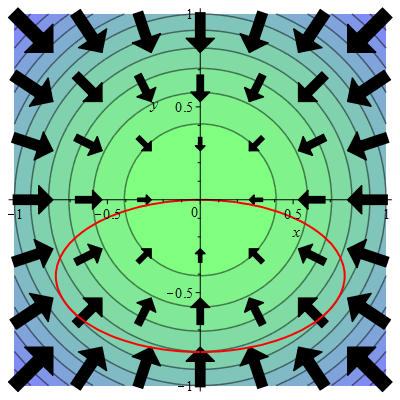
We are looking at a topographic map of a mountain, where the circles represent the level curves of the elevation function. The arrows indicate the gradient vector field of the elevation function. On the mountain, there is an elliptical hiking trail, which is marked in red on the map.
Question a#
Imagine that you are walking along the red hiking trail counterclockwise as seen from above. Find the points on the trail where the slope is 0 (neither uphill nor downhill).
Hint
There are four such points.
Answer
On a level curve, the elevation does not change. Therefore, you need to find the points on the trail where the trail shares a tangent with a level curve.
Question b#
On which parts of the trail are you walking uphill, and on which are you walking downhill?
Question c#
Follow one of the level curves on the map all the way around and observe the direction of the gradient vectors nearby. Conclusion?
Question d#
This mountain is, of course, quite special. But put on your hiking boots again and provide an intuitive argument for why gradient vectors must always, on all mountains, be perpendicular to the level curves.
Answer
Suggestion: If we think of the level curve as a path we are walking along, then the journey is effortless. We are walking horizontally - neither uphill nor downhill - the entire time. It seems natural that the slope would be greatest if we suddenly changed direction by 90 degrees upward. Agree?
2: Continuity of First-Degree Polynomials#
Prove that the polynomial function \(f : \mathbb{R} \to \mathbb{R}\), \(f(x) = 3x\) is continuous at all points \(x \in \mathbb{R}\).
Hint
Use the \(\epsilon-\delta\) definition. See this equation in the textbook.
Hint
Let \(x_0\) be an arbitrary real number, and let \(\epsilon > 0\) be given. You now need to specify how to choose \(\delta > 0\) (it may depend on \(x_0\) and \(\epsilon\)) such that \(|x - x_0| < \delta \Rightarrow |f(x) - f(x_0)| < \epsilon\).
3: Limits of a Function \(f: \mathbb{R}^2 \to \mathbb{R}\)#
Let \(f: \mathbb{R}^2 \to \mathbb{R}\) be given by:
Question a#
Find \(f(x, x)\) for \(x \neq 0\). Then find \(f(y, y)\) for \(y \neq 0\).
Hint
Substitute \(y = x\) into the functional expression. Remember to reduce the fraction.
Hint
When you have found \(f(x, x)\), then \(f(y, y)\) is found by simply replacing \(x\) with \(y\). We are, after all, dealing with the same expression, just with a different variable name.
Answer
For \(x \neq 0\):
Question b#
Determine \(\lim_{x \to 0} f(x,x)\).
Answer
From the expression in the previous Question we see that:
Question c#
Determine \( \lim_{x \to 0} f(x,2x) \).
Hint
Substitute \( y = 2x \) into the expression for \(f(x,y)\) and reduce.
Answer
For \( x \neq 0 \) we get \(f(x,2x) \;=\; \tfrac{2}{5} + x\) and hence
Question d#
Consider whether the limit value \(\lim_{(x,y)\to (0,0)} f(x,y)\) exists.
Answer
As we approach \((0,0)\) along the lines \(y=x\) and \(y=2x\), we approach different values. Since the limit value depends on the path, then \( \lim_{(x,y)\to (0,0)} f(x,y)\) does not exist. This shows that \(f\) is not continuous at \((0,0)\) (even if we were allowed to change the function value \(f(0,0)\)).